13 Falsity, negation and excluded middle
There is one more constructor of well-formed formulas for which we yet have to give natural deduction rules, namely \(\neg\). As we shall momentarily, this one is slightly more involved and we can get different logics depending on which elimination rules we add to our natural deduction system.
13.1 Falsity
The first rule we want is an introduction rule for well-formed formulas of the form \(\neg A\). With our current notion of well-formed formula, though, it is unclear how to go about that. We first need a notion of falsity before we define negation. This means that we need to decide on a well-formed formula that we will use as a marker for rejection.
If we had natural numbers or booleans in our natural deduction system, we could for instance decide to make 0 = 1 or false = true a marker for rejection, in the sense that if a derivation leads to that equality, then the premise of it is rejected. In other words, we would define \(\neg A\) as \(A \Rightarrow (0 = 1)\) or \(A \Rightarrow (\mathrm{false} = \mathrm{true})\). Since we have neither of these equalities in our well-formed formulas, we need to use a different approach. Namely, we introduce a new atomic formula, denoted by \(\bot\) (read as bottom). In the definition of well-formed formulas, this corresponds to adding a constructor, so the definition of \(\mathrm{Wff}\) via its constructors now looks as follows.
- \(P : \mathrm{atoms} \rightarrow \mathrm{Wff}\)
- \(\bot : \mathrm{Wff}\)
- \(\neg : \mathrm{Wff} \to \mathrm{Wff}\)
- \(\Rightarrow : \mathrm{Wff} \to \mathrm{Wff} \to \mathrm{Wff}\)
- \(\wedge : \mathrm{Wff} \to \mathrm{Wff} \to \mathrm{Wff}\)
- \(\vee : \mathrm{Wff} \to \mathrm{Wff} \to \mathrm{Wff}\)
Recall indeed that we have redefined \(A \Leftrightarrow B\) as (A B) (B A)$. Note that we do not need more to use \(\bot\) in natural deduction rules. For instance, for every context \(\Gamma\), the sequent \(\Gamma \vdash \bot \Rightarrow \bot\) holds (by Theorem 10.1). In any case, the well-formed formula \(\bot\) will be characterised by the fact that it has no introduction rule! This is what makes it a good notion of falsity: we do not have a way of deducing it, so if we ever do we should reject the assumption that got us there. This point of view will be formalised in the next section.
As a final remark, we note that, to give a Boolean interpretation for this now enriched notion of well-formed formula, we still start from a valuation \(\nu : \text{atoms} \rightarrow \text{bool}\) defined only on so-called atomic formulas and we extend it to \(\bot\) by setting \([\bot]_\nu = \widehat{\nu}(\bot) := \text{false}\), with Definition 5.2 remaining otherwise unchanged.
13.2 Negation
Now that we have one more constructor \(\bot\) for well-formed formulas, with no introduction rule for it in natural deduction, let us use it to give some introduction and elimination rules for negation.
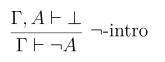
So, for instance, the sequent \(\Gamma \vdash \neg \bot\) holds, as follows from the focus rule. What makes ¬-intro is reasonable is the fact that we have not defined an introduction rule for \(\bot\), so if somehow we manage to derive it, it is a sign that there is something 🐟-y going on.
For the elimination rule of negation, the idea is to convey that \(\neg A\) contradicts \(A\) in a formal way.
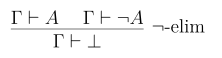
In particular, the following rule holds, which leads us to reject \(A \wedge \neg A\) (since we can deduce \(\bot\) from it in any given context).
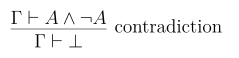
Note that, for every valuation \(\nu : \text{atoms} \rightarrow \text{bool}\), we have \([A \wedge \neg A]_\nu = \text{false}\), by definition of Boolean semantics, so the Boolean interpretation of well-formed formulas is still sound when we add the contradiction rule to our natural deduction system. On the syntactic side, we can prove the following.
Theorem 13.1 Let \(\Gamma\) be a context and let \(A\) be a well-formed formula. Then \(\Gamma \vdash \neg A \Leftrightarrow (A \Rightarrow \bot)\) holds.
Proof. 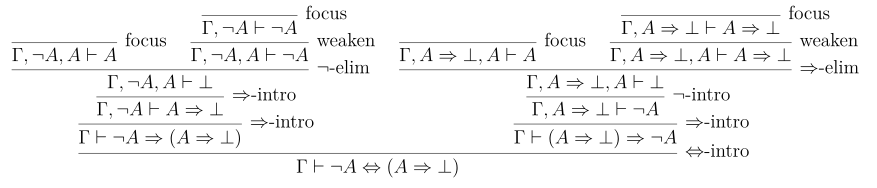
We now have an introduction rule and an elimination rule for well-formed formulas of the form \(\neg A\). Based on those, we have in fact proved in Theorem 13.1 that \(\Gamma \vdash \neg A \Leftrightarrow (A \Rightarrow \bot)\) holds for every context \(\Gamma\) (in particular the empty context), which suggests that we could in fact redefine \(\neg A\) as \(\neg A := A \Rightarrow \bot\) (just like we redefined \(A \Leftrightarrow B\) as \(A \Leftrightarrow B := (A \Rightarrow B) \wedge (B \Rightarrow A)\)). Indeed, the ¬-intro and ¬-elim rules are obtained by replacing \(A \Rightarrow \bot\) by \(\neg A\) in the introduction and elimination rules for \(A \Rightarrow \bot\).

Note that this is not a problem for semantics. Indeed, for every valuation \(\nu : \mathrm{atoms} \Rightarrow \mathrm{bool}\), we have \([\neg A] = \mathrm{negb}([A]_\nu)\) and \([A \Rightarrow \bot] = [A]_\nu \preccurlyeq [\bot]_v = [A]_\nu \preccurlyeq \text{false}\), due to our choice for \([\bot]_\nu\). We then see that both formulas evaluate to the same Boolean value in all cases, namely \(\text{true}\) if \([A]_\nu = \text{false}\) and \(\text{false}\) if \([A]_\nu = \text{true}\). We also note that \([\bot]_\nu = \text{false}\) is the only possibility if we want the Boolean interpretation to remain sound given our choice of introduction and elimination rules for \(\neg A\). We then arrive at a minimal framework for deductive reasoning.
Definition 13.1 (Minimal logic) Consider atomic formulas \(P : \text{atoms} \rightarrow \text{Wff}\) along with constructors \(\bot\), \(\Rightarrow\), \(\wedge\) and \(\vee\) for well-formed formulas. The natural deduction system consisting of the introduction and elimination rules we have given for \(\Rightarrow\), \(\wedge\) and \(\vee\) will be called minimal logic. We will denote its sequents by \(\Gamma \vdash_m A\).
In this formal system, we also have well-formed formulas \(A \Leftrightarrow B := (A \Rightarrow B) \wedge (B \Rightarrow A)\) and \(\neg A := A \Rightarrow \bot\), with inherited introduction and elimination rules. Note that ⊥ has neither an introduction nor an elimination rule in minimal logic (but ¬ does).
13.3 Explosion
Let us enrich minimal logic by adding to it an elimination rule for ⊥. It represents the principle, used in deductive reasoning at least since Aristotle, that from falsehood, anything (follows) (ex falso (sequitur) quodlibet, in its famous Latin version). We can formalise this by saying that \(\bot \Rightarrow A\) should be a theorem for every well-formed formula \(A\) (in a Hilbert system, we could add it as an axiom), or we can write the following natural deduction rule.
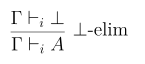
Note that we write \(\vdash_i\) to indicate that we are now working in a richer logic than what we had with \(\vdash_m\). The i in the notation stands for intuitionistic. This addition of a rule only affects the natural deduction system we consider: the set of well-formed formulas in intuitionistic logic is the same as in minimal logic.
Definition 13.2 (Intuitionistic logic) The natural deduction system obtained by adding the ⊥-elim rule to the minimal logic of Definition 13.1 will be called intuitionistic logic. We will denote its sequents by \(\Gamma \vdash_i A\).
If we combine this with the contradiction rule in minimal logic (which follows from ¬-elim), we get the following explosion principle, according to which, in order to deduce \(B\) from \(\Gamma\) in intuitionistic logic, it suffices to find a well-formed formula \(A\) such that \(A \wedge \neg A\) can be deduced from \(\Gamma\).
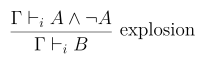
This is quite powerful, since \(A\) does not have to be related to \(B\) at all, only to \(\Gamma\), and the proof goes as follows.
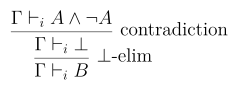
In practice, this becomes particularly interesting when we can identify a specific \(A\) that is already in the context, which reduces the task at hand (of proving \(A \wedge \neg A\)) to proving \(\neg A\). Intuitively it says that, if \(\Gamma \vdash A \Rightarrow \bot\) holds, then from \(\Gamma, A\) we can deduce anything.
Theorem 13.2 (Additional elimination rule for \(\neg\) in intuitionistic logic) 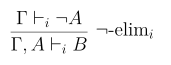
Proof. 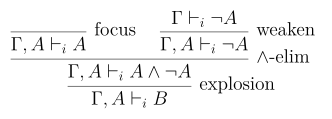
Exercise 13.1 As a converse to what we did above, prove the ⊥-elim rule using the explosion rule.
13.4 Excluded middle
Recall the elimination rule for disjunction.

For \(B = \neg A\), it says the following.

We could call a well-formed formula \(A\) such that \(\Gamma \vdash_m A \vee \neg A\) a decidable formula, or a \(\Gamma\)-decidable formula if we wanted to emphasize that this may depend on the context. For instance, if \(A \in \Gamma\), then \(A\) is certainly decidable in context \(\Gamma\). There is another approach, which consists in saying that every formula is decidable, meaning adding the following rule, which we can call excluded middle.
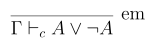
Definition 13.3 (Intuitionistic logic) The natural deduction system obtained by adding the excluded middle rule to the intuitionistic logic of Definition 13.2 will be called classical logic. We will denote its sequents by \(\Gamma \vdash_c A\).
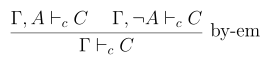
Technically, excluded middle should perhaps refer to the following natural deduction rule of classical logic, which says that, in order to deduce \(C\), it suffices to do it under assumption \(A\) and under assumption \(\neg A\), where \(A\) can be any well-formed formula.
13.5 Double negation elimination
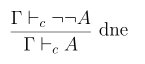
The main practical application of excluded middle is the following rule, known as double negation elimination, which is of frequent use in traditional mathematics. It says that, in order to deduce \(A\) from \(\Gamma\), it suffices to prove that \(\neg A \Rightarrow \bot\) holds in context \(\Gamma\), i.e. that \(\neg A\) leads to falsity.
Theorem 13.3 (Double negation elimination) In classical logic, the following rule holds, for every context \(\Gamma\).
Proof. 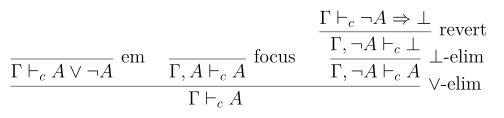
This concludes the proof since, by definition, \(\neg \neg A = \neg A \Rightarrow \bot\) (which in turn is equal to \((A \Rightarrow \bot) \Rightarrow \bot\)).
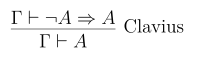
Note that if we did not want to use \(\bot\)-elim (only minimal logic + em), we would get the following rule as a (weaker) replacement for double negation elimination, which is proved almost exactly as above. It says that, in order to prove \(A\), we can assume \(\neg A\). 🤪
Exercise 13.2 (Consequentia mirabilis, also called Clavius’s law) Assume that em and the rules of minimal logic hold and show that the following rule holds for every context \(\Gamma\).
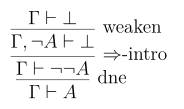
Theorem 13.3 says that dne follows from ⊥-elim and em. To conclude this lecture, let us show that, conversely, dne implies ⊥-elim.
We will see later that dne also implies em. Here are some mnemonics for this sort of considerations.
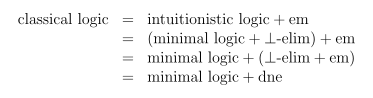
In particular, one could also choose to work with other types of logic, such as minimal logic + em, or minimal logic + Clavius, or minimal logic + em + Clavius. In mathematics, one usually works with classical logic, but intuitionistic logic has the advantage that it provides a common foundation for mathematics and functional programming languages such as the ones used in modern proof assistants.