15 Predicates, subtypes, and relations
Let us give an introduction to a few notions that are particularly useful to formalise mathematics.
15.1 Predicates
We have encountered predicates informally before. Here is the formal definition.
Definition 15.1 (Predicate) Let \(X\) be a set. A function \(P : X \to \mathrm{Prop}\) is called a predicate on \(X\).
Most of the predicates we have seen have been defined inductively. But this does not have to be the case. Regardless, if \(P : X \to \mathrm{Prop}\) is a predicate on \(X\), then for all \(x : X\), \(P(x)\) is a proposition, representing a property that \(x\) may or may not have. More precisely, we say that \(x\) has the property in question if and only if \(P(x)\) has a proof.
Example 15.1 (Even natural numbers) Let us use an inductively-defined predicate to formalise the property that a natural number is even.
One way to do this is to say that \(n\) is even if there is a natural number \(k\) such that \(n = k + k\). The following definition means that
dbl kis evidence for the fac t thatk + kis even.Inductive IsEven : nat → Prop := | dbl (k : nat) : IsEven (k + k)Another approach to the predicate
IsEven : nat → Propis as follows. By definition, \(0\) is considred even (which we formalise by giving evidence for it), and, if \(n\) is known to be even, then \(n + 2\) is also even. Note that we useS (S n)instead ofn + 2, to facilitate computation (a simple precaution?).Inductive IsEven' : nat → Prop := | zero_is_even : IsEven' 0 | succ_succ_even_is_even (n : nat) : IsEven' n → IsEven' (S (S n))
Note that, with both definitions, a proposition such as IsEven 5 typechecks just fine.
Exercise 15.1 Using each of the definitions in Example 15.1, show that \(0, 2\) and \(4\) are even natural numbers.
As mentioned earlier, defining predicates inductively is quite common, and usually convenient. In the case of IsEven : nat → Prop, another approach is possible. Namely, \(0\) is even, \(1\) is not even, and (recursively) \(n + 2\) is even if and only if \(n\) is even.
Fixpoint even (n : nat) : Prop :=
match n with
| 0       => True
| 1       => False
| S (S n) => even n
The difference with the inductive approach is that, here, the proposition even n is defined explicitly for all n (it evaluates to True or False). If we follow this approach, we can also define the property of being even using a bool-valued predicate, the difference being that evenb is a boolean value, so it does not makes sense to speak of “a proof of evenb n”.
Fixpoint evenb (n : nat) : bool :=
match n with
| 0       => true
| 1       => false
| S (S n) => evenb n
Finally, there is a definition of the predicate IsEven : nat → Prop that uses mathematical notation as supported in Rocq.
Definition IsEven'' (n : nat) : Prop := ∃ k : nat, n = k + k.We will not comment on it further at this stage, as it is equivalent to the definition of IsEven in Example 15.1. In particular, we can destruct terms of type IsEven'' n, and do induction on them, exactly as those of type IsEven n.
15.2 Subtypes
Let us go back to abstract predicates. To a predicate \(P : X \to \mathrm{Prop}\), we can associate the following type \(X_P\), called a subtype (or a subset) of \(X\). \[ X_P := \{x : X\ |\ P(x)\} \]
For instance, {n : nat | IsEven n} typechecks as a set.
Check {n : nat | IsEven n}.
  (* : Set *)
The set \(X_P\) represents the subset of \(X\) consisting of all elements \(x\) for which the proposition \(P(x)\) holds. In Rocq, the syntax {x : X | P x} would typecheck. More precisely, we can define a function subset as follows.
Definition subset (X : Set) (P : X → Prop) : Set := {x : X | P x}.For instance, subset nat IsEven represents the subset of even natural numbers. By definition, the elements of the set subtype nat IsEven are pairs (n, p) where n is a natural number and p is a proof of the proposition IsEven n. For instance (2, dbl 1) is of that form, so the following typechecks and the typechecker shows its type as nat * IsEven (1 + 1) because 2 is of type nat and dbl 1 is of type IsEven (1 + 1).
Check (2, dbl 1).
  (* (2, dbl 1) : nat * IsEven (1 + 1) *)
Note that, if we use a bool-valued predicate instead, and identify bool with the set \(\{0, 1\}\), then \(P : X \to \{0, 1\}\) is the characteristic function of the subset \(X_P\). Namely, \(P(x) = 1\) if and only if \(x \in X_P\). However, this is not how we think of subsets in Rocq or more generally when we formalise mathematics using a type-theoretic approach.
The precise introduction and elimination rules that define \(X_P\) as a type are a bit involved, so we will skip them for now. Instead, we reason about the predicate \(P : X \to \mathrm{Prop}\) directly. For instance, if we want to prove that the sum of two even natural numbers is even, we write the following.
Theorem 15.1 (A sum of even natural numbers is even) For all \(m, n : \mathbb{N}\), if \(m\) is even and \(n\) is even, then \((m + n)\) is even.
Or, as a (curried) Rocq function:
Theorem add_even : ∀ m n : nat, IsEven m → IsEven n → IsEven (m + n).Proof. For the proof, let us introduce natural numbers m and n, a proof Hm that m is even and a proof Hn that n is even.
intros m n Hm Hn.By definition of being even, this means that there exists a p : nat such that m = p + p and a q : nat such that n = q + q. So now m + n = (p + p) + (q + q) and we have to prove that this natural number is even.
destruct Hm as [p], Hn as [q].By an algebraic manipulation we can replace (p + p) + (q + q) by (p + q) + (p + q), which is even because it is of the form k + k for k = p + q.
assert ((p + p) + (q + q) = (p + q) + (p + q)) as H by admit.
rewrite H.
More precisely, the proposition IsEven ((p + q) + (p + q)) holds because we can give the evidence dbl (p + q) for it.
exact (dbl (p + q)).And we will leave it at that for now 🙂 .
If we insist on using subsets, we can use Theorem add_even to construct a function add_even_numbers with the following signature.
Definition add_even_numbers : {n : nat | IsEven n} → {n : nat | IsEven n} → {n : nat | IsEven n}.
Proof.
  intros a b.
  destruct a as [m Hm], b as [n Hn].
  exists (m + n).
  exact (add_even m n Hm Hn).
Defined.
This is sometimes useful but unnecessarily complicated for us at this stage. Note in particular that there is more than one function with the same type signature (think of multiplication of even numbers, for instance). Note that we can also provide a definition of the function add_even_numbers without making use of Rocq’s tactical language.
Definition add_even_numbers : {n : nat | IsEven n} → {n : nat | IsEven n} → {n : nat | IsEven n} :=
  fun a b =>
    match a, b with exist _ m Hm, exist _ n Hn =>
      exist _ (m + n) (add_even m n Hm Hn)
    end.
We also point out, without getting into the details, that the proof of Theorem 15.1 is less straightforward if we use the definition IsEven' of Example 15.1. So instead we should prove that the two definitions are equivalent, which we will do in the next lecture.
15.3 Relations
According to the definition we gave above, predicates on a type \(X\) are just unary functions \(P : X \to \mathrm{Prop}\). We now consider binary such functions, which are more commonly called relations on \(X\).
Definition 15.2 (Relations) Let \(X\) be a set. A function \(R : X \to X \to \mathrm{Prop}\) is called a relation on \(X\).
This means that, for all \(x, y : X\), we have a proposition \(R(x, y)\) and a proof of that proposition is evidence for the fact that the relation holds between \(x\) and \(y\). As a running example, we will use the following relation between natural numbers.
Example 15.2 (Ordering on \(\mathbb{N}\)) Let us introduce a relation on nat inductively as follows.
Inductive leq : nat → nat → Prop :=
| zero_leq  : ∀ (n : nat), leq 0 n
| succ_mono : ∀ (m n : nat), leq m n → leq (S m) (S n).

Infix "≤" := leq (at level 70, no associativity).
So, for instance, zero_leq 3 is a proof that 0 ⩽ 3 and succ_mon 0 3 (zero_leq 3) is a proof that 1 ⩽ 4. Similarly, if we want to construct a proof of 2 ⩽ 5, we use succ_mon 1 4 h, where h is a proof of 1 ⩽ 4. In tactical language, this can be written as follows.
Goal (2 ≤ 5).
Proof.
  apply succ_mono.
  apply succ_mono.
  apply zero_leq.
Qed.
Let us now see how to study properties of a relation R : X → X → Prop. For instance, how can we express, in our meta-language (i.e. Rocq), that the relation ≤ : nat → nat → Prop is:
- reflexive?
- transitive?
- anti-symmetric?
Definition 15.3 (Properties of relations) Let \(X\) be a type and let \(R : X \to X \to \mathrm{Prop}\) be a relation. The relation \(R\) is called:
- reflexive if the following proposition holds: \(\forall x : X, R(x,x)\).
- transitive if \(\forall x, y, z : X, R(x,y) \to R(y,z) \to R(x,z)\).
- symmetric if \(\forall x, y : X, R(x,y) \to R(y,x)\).
- anti-symmetric if \(\forall x, y : X, R(x,y) \to R(y,x) \to x =_X y\).
If \(R\) is reflexive, transitive and symmetric, we say that \(R\) is an equivalence relation. If \(R\) is reflexive,transitive and anti-symmetric, we say that \(R\) is an ordering (or order relation) on \(X\). A relation that is reflexive and transitive is called a pre-ordering.
Note that the anti-symmetry property of \(R\) involves the equality relation on \(X\) and is a kind of extensionality property for \(R\). Let us now prove informally that the relation leq : nat → nat → Prop is reflexive and transitive. We will see formal proofs of these facts later on.
Theorem 15.2 (≤ is reflexive) For all n : nat, n ≤ n.
Proof. To prove this, we introduce n : nat and we reason by induction on n.
- The base case is
n = 0, for which the goal becomes0 ≤ 0, which is proved byzero_leq 0. - For the induction step, we assume that
n ≤ nand we want to prove thatn + 1 ≤ n + 1. This is proven by applyingsucc_mono n n, because the latter is a proof ofn ≤ n → n + 1 ≤ n + 1.
Theorem 15.3 (≤ is transitive) For all p q r : nat, p ≤ q → q ≤ r → p ≤ r.
Proof. To prove this, we introduce natural numbers p q r : nat and proofs H1 : p ≤ q and H2 : q ≤ r. Contrary to Theorem 15.2, we will not reason by induction on a natural number but by induction on the proof H1 of the proposition p ≤ q.
- The base case is when
H1 = zero_leq q, which forcesp = 0. But then the goal is0 ≤ r, so we can prove it byzero_leq r. - The inductive step is when
H1 = succ_mono p' q' H', whereH'is a proof ofp' ≤ q'. In this case, we necessarily havep = S p'andq = S q'. Soq ≤ ris of the formS q' ≤ r, which forcesrto be of the formS r'. SoH2is now a proof ofS q' ≤ S r'. This can only occur ifH2is of the formsucc_mono q' r' H'', whereH''is a proof ofq' ≤ r'. We should now be able to apply the induction hypothesis toH' : p' ≤ q'andH'' : q' ≤ r'to obtain a proof ofp' ≤ r'. Next, applyingsucc_mono p' r'to the proof ofp' ≤ r'that we have just constructed, we obtain a proof ofS p' ≤ S r', i.e.p ≤ r, which concludes the induction.
Convincing as it may seem, the proof above does not quite go through if we try to formalise it as such, because of the shape of the induction hypothesis. We want to apply it to H' : p' ≤ q' and H'' : q' ≤ r', but the issue is the argument r'. The way we wrote the proof, the induction hypothesis will be of the form q' ≤ S r' → p' ≤ S r', because r was fixed when we started the induction. So we should in fact have reverted r (hence also H2) to the context before starting the induction on H1, which then gives an induction hypothesis of the form ∀ r, q' ≤ r → p' ≤ r and the latter can be applied with r = r'. We will see the details later, when we formalise this in Rocq.
We leave the anti-symmetry property of leq as an exercise. A formal proof will be given later on.
Exercise 15.2 (≤ is anti-symmetric) Show that, for all m n : nat, m ≤ n → n ≤ m → m = n.
15.4 Decidability
Sometimes, when we have a predicate \(P\) or a relation \(R\) on a set \(X\), it is useful to be able to distinguish cases according to whether the proposition \(P(x)\) or \(R(x,y)\) holds. This type of cases analysis is related to the destruction rule for disjunction
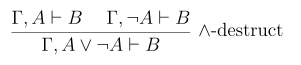
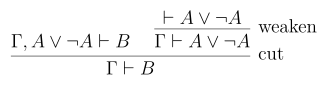
for which we need to have a proof of \(A \vee \neg A\) in the context. When we can assume that much, we will say that the formula \(A\) is decidable. More precisely, if we want to prove that \(\Gamma \vdash B\) holds, then, by the cut rule, it suffices to prove that \(\Gamma, A \vee \neg A \vdash B\) and \(\Gamma \vdash A \vee \neg A\) hold. The latter sequent \(\Gamma \vdash A \vee \neg A\) will be referred to as \(A\) being decidable in context \(\Gamma\). In particular, if \(A\) is decidable in the empty context (in which case we just say that \(A\) is decidable), then \(A\) is decidable in any context (as follows from the weakening rule).
Definition 15.4 (Decidable propositions, predicates and relations) Let \(X\) be a set. Let \(p : \mathrm{Prop}\) be a proposition, let \(P : X \to \mathrm{Prop}\) be a predicate on \(X\), and let \(R : X \to X \to \mathrm{Prop}\) be a relation on \(X\). We say that:
- \(A\) is a decidable proposition if the proposition \(A \vee \neg A\) holds.
- \(P\) is a decidable predicate if, for all \(x : X\), the proposition \(P(x)\) is decidable, meaning that the proposition \(P(x) \vee \neg P(x)\) holds.
- \(R\) is a decidable relation if, for all \(x, y : X\), the proposition \(R(x,y)\) is decidable, meaning that the proposition \(R(x,y) \vee \neg R(x,y)\) holds.
For instance, the predicate IsEven : nat → Prop of Example 15.1 is decidable, which, in practice, has at least two applications:
- Given an explicit natural number such as \(7\) or \(42\), we can evaluate whether this number is even and return a value such as
trueorfalsefor it. - If we want to prove a property \(P(n)\) for all natural numbers \(n\), we can distinguish cases according to whether \(n\) is even or not and if we prove it in each case, we are done.
The first application is actually related to how the proposition IsEven n can be shown to be decidable: one defines a function mod 2 : nat → nat and proves that n mod 2 = 0 if and only if n is even. Note that the fact that decidability essentially amounts to a decisison procedure to say whether a proposition holds or its negation holds is linked to the definition of the connective ∨ in our logic: to prove A ∨ B, one must be able to either prove A or B. Here we are implictely using that n mod 2 = 0 is itself a decidable proposition because equality between natural numbers is a decidable relation, which we now prove.
Theorem 15.4 (Equality between natural numbers is decidable) Let \(m\) and \(n\) be natural numbers. Then the following proposition holds: \[ (m = n) \vee (m \not= n). \]
Proof. Recalle that \(m \neq n\) means \(m = n \to \mathrm{False}\). We prove by induction on \(m\) that, \(\forall n : \mathbb{N}, (m = n) \vee (m \not= n)\).
For \(m = 0\), we have to prove that \(\forall n : \mathbb{N}, (0 = n) \vee (0 \not= n)\). By construction of \(\mathbb{N}\), it suffices to consider the cases \(n = 0\) and \(n = 1 + k\), for some \(k : \mathbb{N}\).
- When \(n = 0\), we have to show that \((0 = 0) \vee (0 \not= 0)\), which we prove by showing \(0 = 0\) (which in turn holds by reflexivity).
- When \(n = 1 + k\), we have to prove that \((0 = 1 +k) \vee (0 \not= 1 +k)\), which we prove by showing \(0 \not= 1 + k\). Indeed, a proof of \(0 = 1 + k\) would contradict the definition of the succesor function as a constructor for \(\mathbb{N}\) that is distinct from the atomic constructor \(0\).
Now let us assume that the induction hypothesis holds for \(m\) and let us prove that it holds for \(1 + m\). This means that we are assuming that we have a proof of the proposition \(\forall n : \mathbb{N}, (m = n) \vee (m \not= n)\) and that we want to prove the proposition \(\forall n : \mathbb{N}, (1 + m = n) \vee (1 + m \not= n)\). Again, it suffices to consider the cases \(n = 0\) and \(n = 1 + k\) for some \(k : \mathbb{N}\).
When \(n = 0\), we have to show that \((1 + m = 0) \vee (1 + m \not= 0)\), which we prove by showing, as earlier, that \(1 +m \not= 0\).
When \(n = 1 + k\), we have to show that \((1 + m = 1 + k) \vee (1 + m \not= 1 + k)\). We will distinguish cases according to the disjunction \((m = k) \vee (m \not= k)\), which we get from the induction hypothesis applied with \(n = k\).
- If \(m = k\) holds, then by congruence \(1 + m = 1 + k\).
- If \(m \not= k\) holds, then we will show that \(1 + m \not= 1 + k\). Indeed, if we had \(1 + m = 1 + k\), then by inversion of the successor function, we would get \(m = k\), which would then contradict \(m \not= k\) (meaning that out of these two we could get a proof of \(\mathrm{False}\), which is our goal).
This concludes the induction, hence also the proof. As an exercise, one can formalize this proof in Rocq, using the
inversiontactic to handle the reasoning about the constructors.
We conclude with two exercises. The first one is about showing that the usual order relation on \(\mathbb{N}\) is decidable. The second is about how to use decidability to prove the direction that does not hold constructivel in De Morgan’s second law.
Exercise 15.3 (Decidable ordering) Let ≤ be the order relation on nat introduced in Example 15.2. Show that, for all m n : nat, (m ≤ n) ∨ ¬(m ≤ n).
Exercise 15.4 (Decidability in De Morgan’s second law) Let P and Q be propositions and assume that P is decidable or Q is decidable. Show that ¬(P ∧ Q) → ¬P ∨ ¬Q.